Overview
PCR (polymerase chain reaction) is a method to analyze a short sequence of DNA (or RNA) even in samples containing only minute quantities of DNA or RNA. PCR is used to reproduce (amplify) selected sections of DNA or RNA. Previously, amplification of DNA involved cloning the segments of interest into vectors for expression in bacteria, and took weeks. But now, with PCR done in test tubes, it takes only a few hours. PCR is highly efficient in that untold numbers of copies can be made of the DNA.
The steps of PCR
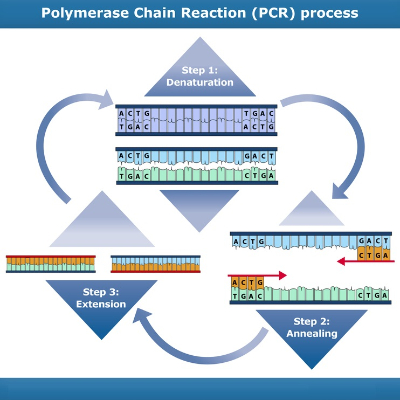
Three major steps are involved in a PCR.These three steps are repeated for 30 or 40 cycles.The key ingredients of a PCR reaction are Taq polymerase, primers, template DNA, and nucleotides (DNA building blocks). The ingredients are assembled in a tube, along with cofactors needed by the enzyme, and are put through repeated cycles of heating and cooling that allow DNA to be synthesized.The basic steps are:
Denaturation (At 94 C (201.2 F): Heat the reaction strongly to separate, or denature, the DNA strands. This provides single-stranded template for the next step.
Annealing (At medium temperatures, around 54 C (129.2 F): Cool the reaction so the primers can bind to their complementary sequences on the single-stranded template DNA.
Extension (At 72 C (161.6 F): Raise the reaction temperatures so Taq polymerase extends the primers, synthesizing new strands of DNA.
Purpose of doing a PCR
The results of a PCR reaction are usually visualized (made visible) using gel electrophoresis. Gel electrophoresis is a technique in which fragments of DNA are pulled through a gel matrix by an electric current, and it separates DNA fragments according to size. A standard, or DNA ladder, is typically included so that the size of the fragments in the PCR sample can be determined.PCR is used in many research labs, and it also has practical applications in forensics, genetic testing, and diagnostics. For instance, PCR is used to amplify genes associated with genetic disorders from the DNA of patients (or from fetal DNA, in the case of prenatal testing). PCR can also be used to test for a bacterium or DNA virus in a patient's body: if the pathogen is present, it may be possible to amplify regions of its DNA from a blood or tissue sample.HIV-1 DNA, Qualitative, PCR is a sensitive method for detection of pro-viral DNA. It has been used in the management of perinatal HIV infection. HIV-1 RNA has recently been confirmed equally as sensitive and specific for this purpose.Looking for "blood draw near me?". Tuhealthy App helps you to labs order for the PCR test.