Overview
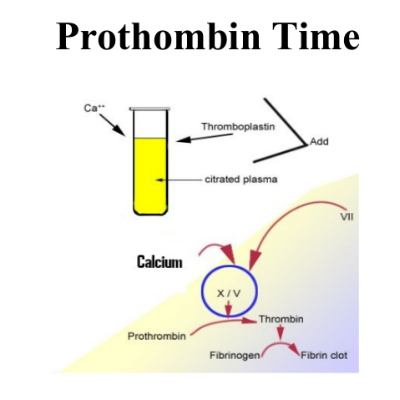
When you get a cut, your body jumps into action to keep things from getting out of hand. Cells called platelets get there first to slow the bleeding. Then, a bunch of proteins, called clotting factors, show up. They all fit together to form a solid mass -- a blood clot -- to stop the bleeding so you can start healing.That’s what typically happens. But if you tend to bleed easily or you get clots when you shouldn’t, then you may have a problem with your clotting factors.That’s when you might need a prothrombin time test, which measures how quickly your blood clots. Prothrombin time (PT) is a blood test that measures the time it takes for the liquid portion (plasma) of your blood to clot.Often used for identifying bleeding problems, it is also used to check if medicines (mostly Warfarin) that prevent blood clots are effectively working. A PT test is referred to as an INR Test, where INR stands for International Normalised Ratio and is a method of standardizing the results of the Prothrombin Test, irrespective of the testing method. This can be done using the INR System and enables the doctor to analyse reports from different labs. Prothrombin Test is important as it checks for the presence of five different blood clotting factors (factors I, II, V, VII, and X). Prothrombin or Factor II is made by the liver aided by a sufficient amount of Vitamin K. A doctor suggests a PT Test for symptoms such as excessive bleeding, bleeding gums, blood in urine or stool, heavy periods for women, bone marrow and liver problems, Vitamin K deficiency and leukemia.
Why is a prothrombin time test performed?
Your doctor might recommend a prothrombin time test to Monitor the effectiveness of a blood-thinning medication that you're taking Diagnose liver problems,Assess your blood's ability to clot before you have surgery or The prothrombin time test is one of several tests used to screen people waiting for liver transplants. That screening — known as the model for end-stage liver disease (MELD) — is a scoring system for assessing the severity of chronic liver disease.When you have a prothrombin time test, you might also have an Additional testing to assess the health of your liver, if your doctor suspects you have liver problems,Additional clotting-function tests, if your doctor suspects you have a bleeding disorder. Prothrombin Time with INR is a Screening test for abnormalities of coagulation factors that are involved in the extrinsic pathway. Also used to monitor effects of Warfarin therapy and to study patients with hereditary and acquired clotting disorders.Looking for cheap blood testing near me?. Do your lab order though Tuhealthy App.
What do the test results mean?
Blood plasma normally takes between 11 and 13.5 seconds to clot if you’re not taking blood-thinning medication. PT results often are reported as an international normalized ratio (INR) that’s expressed as a number. A typical range for a person not taking blood thinner medication is 0.9 to about 1.1. For someone taking warfarin, the planned INR is usually between 2 and 3.5.If your blood clots within the normal amount of time, you probably don’t have a bleeding disorder. If you are taking a blood thinner, a clot will take longer to form. Your doctor will determine your goal clotting time.If your blood doesn’t clot in the normal amount of time, you may be on the wrong dose of warfarin,have liver disease,have vitamin K deficiency or have a bleeding disorder, such as factor II deficiency.If you have a bleeding disorder, your doctor may recommend factor replacement therapy or a transfusion of blood platelets or fresh frozen plasma.
Prothrombin Time with INR test Reference Range(s) are
PT : 9.0-11.5 sec
INR
Reference range : 0.9-1.1
Moderate-intensity Warfarin therapy : 2.0-3.0
Higher-intensity Warfarin therapy : 3.0-4.0